
Top 5 Industries about to be taken over by blockchain
As more industries embrace blockchain, we’re on the brink of seeing it evolve from a niche technology to a mainstream solution that will transform how we live and work.
As more industries embrace blockchain, we’re on the brink of seeing it evolve from a niche technology to a mainstream solution that will transform how we live and work.
Blockchain gets talked about like it's still mostly a crypto story. It isn't. Banks are building shared settlement networks on it. Retailers are tracing food shipments with it. Musicians are collecting royalties through it. If you want the fundamentals first, here's how blockchain technology actually works.
None of this is speculative. Real institutions are running real pilots and, in some cases, full production systems on blockchain infrastructure right now, for reasons that have nothing to do with buying or selling crypto.
Here's where blockchain has moved from experiment to actual use, industry by industry, and what's genuinely working versus what's still early.
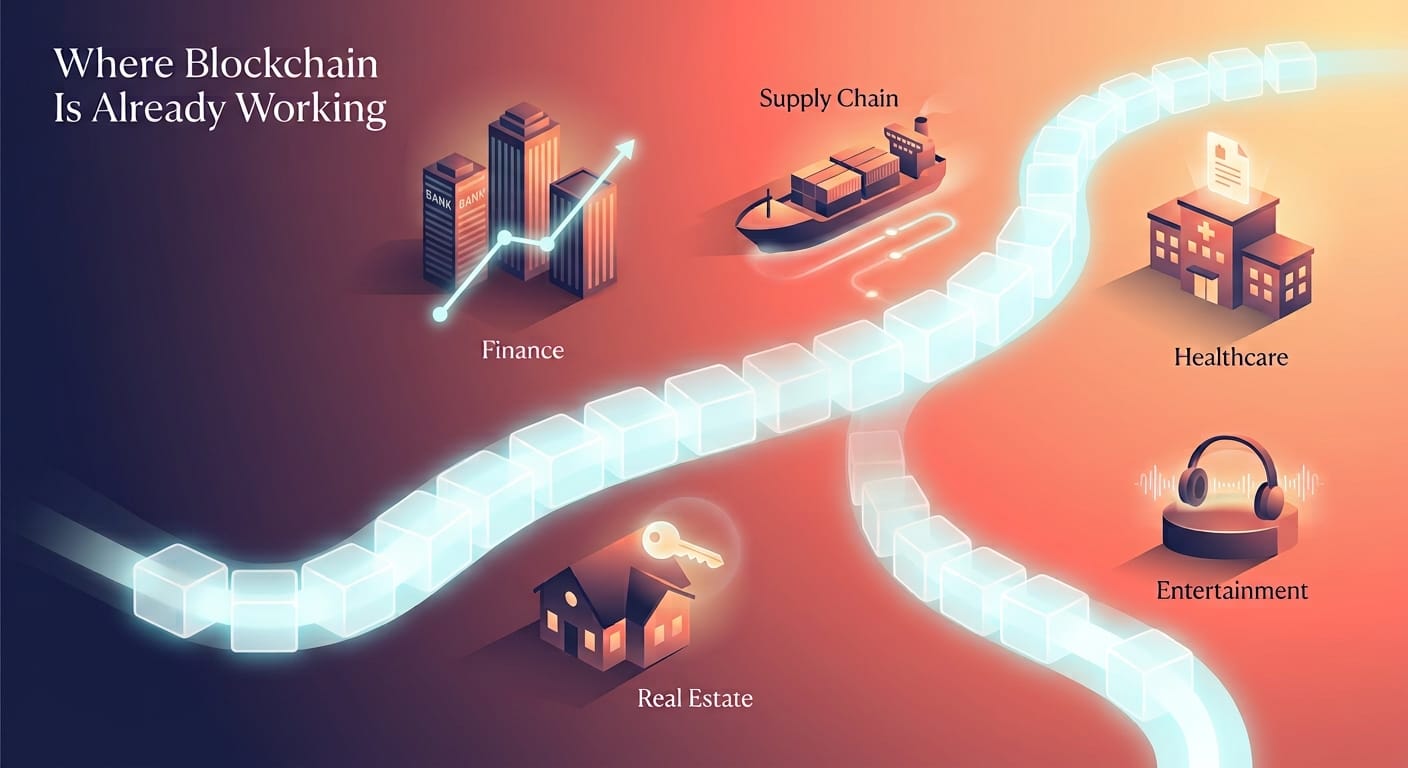
Cross-border payments have always had the same problem: money can leave one bank in minutes, then sit for days once it reaches the receiving country's local banking system. That gap, not the international transfer itself, is where most of the delay actually happens.
SWIFT, the messaging network nearly every bank in the world relies on, is now building a blockchain-based shared ledger specifically to close that gap. More than 50 banks across 25-plus countries, including HSBC, Deutsche Bank, JPMorgan, and Standard Chartered, are participating in a framework targeting real-time, 24/7 settlement. The first wave is set to launch by mid-2026, aimed squarely at major remittance corridors like India, Pakistan, Bangladesh, and the Philippines.
That's a meaningful shift. For years, faster cross-border settlement was something only crypto rails like Ripple's could offer. Now the traditional banking system itself is building blockchain infrastructure to compete on the same problem, which says a lot about how seriously the technology is being taken at the institutional level.
Key takeaways:
Supply chains run on trust between parties who often can't fully verify each other's data. A shipper says a product left on time. A distributor says it arrived intact. Without a shared, tamper-resistant record, verifying any of that after the fact is difficult.
IBM's Food Trust platform, built on blockchain since 2018, addresses exactly that problem for food safety. It's now used in real production deployments by major retailers, including Walmart and Carrefour, to track produce from farm to shelf. Wholechain, a lighter alternative focused initially on seafood, has built a strong footprint among smaller North American processors that don't need IBM's full infrastructure.
There's a real regulatory driver behind this, too. The FDA's FSMA 204 rule will require covered food companies to produce detailed tracking records within 24 hours of a request, in electronic, sortable format. The original January 2026 deadline was pushed to 2027 after industry pushback, but the requirement itself isn't going away, and blockchain-based traceability platforms are the clearest way most companies will meet it.
Outside of food, VeChain applies the same idea to luxury goods and pharmaceuticals, verifying authenticity at each step to fight counterfeiting, a growing concern as tokenized luxury goods become a bigger market in their own right.
Key takeaways:
Healthcare has two blockchain use cases that don't get equal attention. One is patient data. The other is drug supply chains, and it deserves more credit than it usually gets.
MedRec, a system developed at MIT, gives patients more direct control over who can access their health records, instead of leaving that entirely in the hands of whichever provider currently holds the file. BurstIQ takes a similar approach for compliant data sharing between multiple healthcare providers, aiming to reduce the friction (and security risk) of moving sensitive records between systems that don't naturally talk to each other.
The supply chain side matters just as much. Counterfeit and diverted pharmaceuticals are a real, ongoing problem, and blockchain-based tracking applies the same farm-to-shelf logic used in food supply chains to medication, verifying that what reaches a pharmacy shelf is what actually left the manufacturer. Similar shared, verifiable data approaches are also being explored in decentralized science initiatives working to fast-track cancer research, another area where trustworthy, multi-party data sharing matters as much as it does in patient records.
Key takeaways:
Real estate has two blockchain applications running at once: modernizing the paperwork, and changing who can actually invest in property at all.
On the paperwork side, Propy facilitates cross-border real estate transactions using digital deeds, cutting down the friction of an industry still built around physical documents, notaries, and county record offices that don't talk to each other across borders.
On the investment side, tokenization is where the bigger shift is happening. Real estate tokenization crossed $10 billion in value in 2026, up from a market that barely existed a few years earlier, and one industry projection puts the space at roughly $4 trillion by 2035. A few concrete examples show what that actually looks like: Kin Capital launched a $100 million tokenized debt fund for accredited investors, Red Swan tokenized a $2.2 billion commercial real estate portfolio, and platforms like Lofty let everyday investors buy fractional shares of rental homes and receive daily rental income in stablecoins rather than waiting on a quarterly check. This is part of a broader tokenization trend reshaping which assets ordinary investors can actually access.
Key takeaways:
Musicians have historically had the least direct relationship with their own royalties of almost anyone in the creative economy, since payments typically pass through multiple layers of labels, distributors, and collection societies before reaching the artist.
Audius, a decentralized music platform, is changing that math directly. In 2026, Audius partnered with the International Copyright Enterprise (ICE) on a multi-territory licensing deal that gives over 330,000 artists, songwriters, and rights holders, many in regions like sub-Saharan Africa and Asia Pacific that previously had limited royalty collection options, a more direct path to getting paid. The deal creates transparent payment channels and cuts out several of the intermediaries that traditionally took a cut before an artist ever saw the money.
This isn't just an efficiency story. For creators in regions where royalty collection infrastructure was weak or nonexistent, direct blockchain-based payment is the difference between getting paid at all and not.
Key takeaways:
Across every industry above, the same three things keep showing up: a shared record multiple parties can trust without a single company controlling it, faster settlement or payment than legacy systems allow, and more direct value flow to the person who actually earned it, whether that's a food producer, an artist, or someone investing in a fraction of a property. The same pattern is showing up in less obvious places too, including efforts to decarbonize the power grid, where blockchain-based systems track and verify renewable energy credits the same way they track a shipment of produce.
None of this requires anyone to buy or hold cryptocurrency. It's blockchain as infrastructure, which is a very different pitch than blockchain as an investment.
Beyond crypto, blockchain is used for cross-border payment settlement, supply chain and food traceability, patient health record control, pharmaceutical authenticity tracking, real estate tokenization, and direct royalty payments in music and media.
It depends on the measure. Finance has the most institutional momentum right now, with major banks building shared infrastructure through initiatives like SWIFT's shared ledger. Real estate has seen the fastest growth in dollar terms through tokenization. Supply chain has the most mature, already-deployed use cases.
It varies significantly by industry. Supply chain traceability through platforms like IBM Food Trust is in real production use at major retailers today. Real estate tokenization has crossed measurable market value. Healthcare blockchain applications are comparatively earlier-stage, with meaningful pilots but less widespread deployment.
Not necessarily. Most of the examples here, like supply chain tracking or patient records, use blockchain purely as a shared, tamper-resistant database. Some, like real estate tokenization and Audius's royalty payments, do involve digital assets, but the core value is the infrastructure, not speculation on price.
A regular database is controlled by one company, which means everyone else has to trust that company's version of events. A blockchain-based system lets multiple independent parties, like a shipper, a retailer, and a regulator, share the same tamper-resistant record without any one of them controlling it outright.

We explain crypto in plain, simple language with no hardcore technical stuff, so getting started feels easy, not overwhelming. Educational content only, not financial advice.
Buy, sell, and trade crypto on the go with RockWallet.