
ACH vs. ETF payments - the best way to buy crypto (US)
ACH vs. ETF payments explained: settlement, fees, and ownership. Learn the best way to buy crypto, then buy and hold in RockWallet.
ACH vs. ETF payments explained: settlement, fees, and ownership. Learn the best way to buy crypto, then buy and hold in RockWallet.
Table of contents
A few months ago, a friend texted me a screenshot of a checkout screen. You've seen the one: ACH payments, debit card, maybe wire, plus a newer curveball: "Should I just do an ETF instead?"
It was 9:14 a.m. on a Tuesday. She was trying to buy crypto, about $100 worth of Bitcoin, before her first meeting. In other words: emotionally speaking, this was not the moment for a dissertation.
So, I replied with the shortest honest sentence I know:
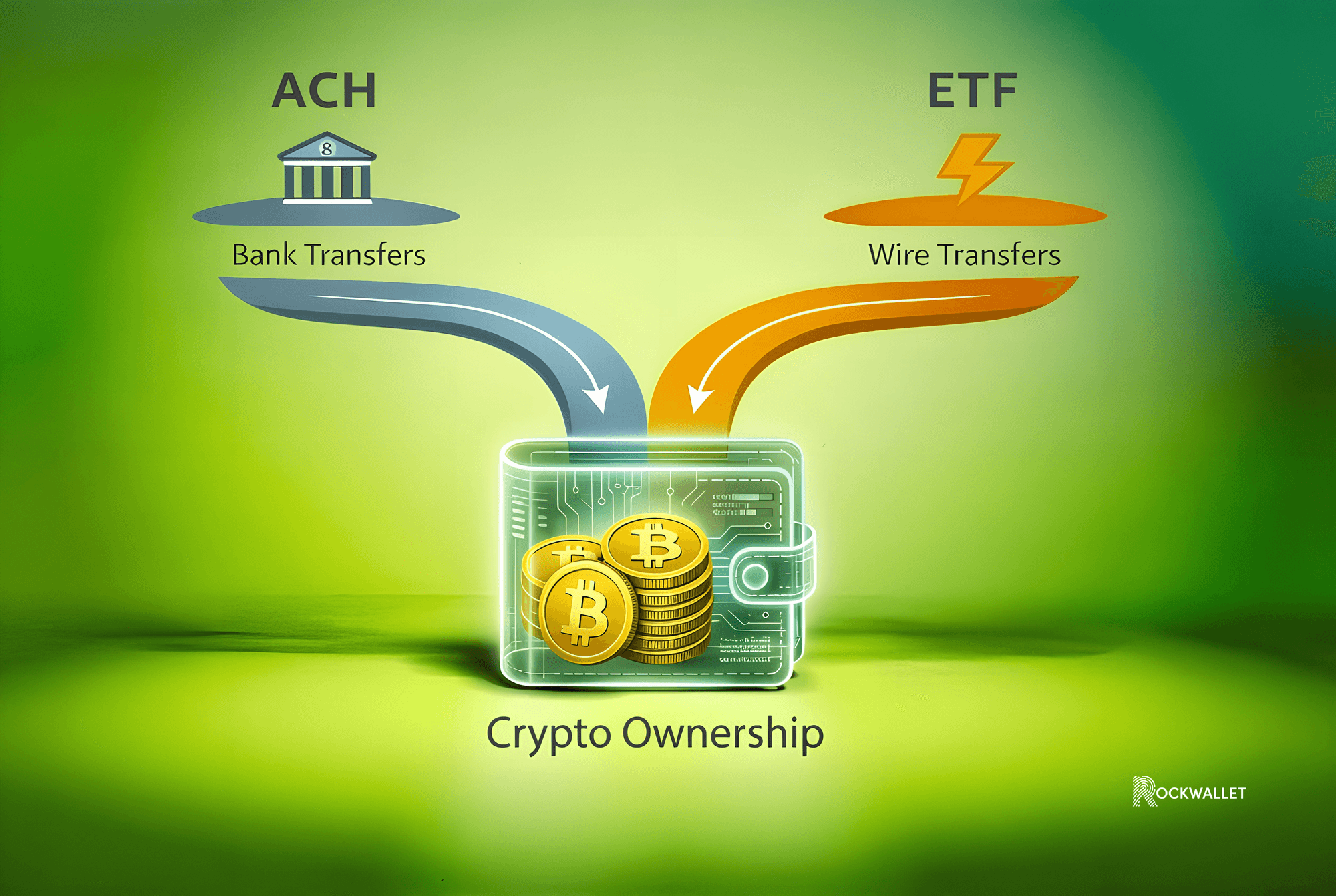
ACH is how money moves. An ETF is what you buy. A wallet is where ownership lives.
That’s the entire map.
And if you’re in the U.S. in 2026, this matters more than ever because crypto is now mainstream enough that you can access it through multiple doors. Some doors give you exposure. Others give you actual crypto, you control.
This guide walks you through the doors, what’s behind each one, and how to choose the best way to buy crypto based on what you want next: hold, learn, send, swap, or simply track price.
Let’s clean up the terminology first because it’s the source of a lot of confusion:
ACH (Automated Clearing House) is a U.S. bank-to-bank transfer network that processes payments in batches. It’s used for things like payroll, bills, and account-to-account transfers.
EFT (Electronic Funds Transfer) is a broad umbrella term. In the U.S., people sometimes say “EFT” when they really mean ACH, but EFT can also refer to other electronic transfers depending on context.
Wire transfers (like Fedwire) are designed for real-time, high-value transfers with immediate, final, irrevocable settlement once processed.
If ACH is the reliable commuter train that runs on a schedule, a wire is the private car: expensive, direct, final.
And debit/credit cards? Those are the food delivery app of payments: fast, convenient, and you do "pay" for that convenience.
People hear “crypto” and expect everything to behave like a text message: instant, global, always-on.
Then they choose ACH and wonder why it’s taking days.
Here’s the honest answer: when you buy crypto with ACH, two systems finish their work:
ACH is efficient, but it’s not built for “right now.” It’s built for “reliably and at scale.”
Now layer in a crypto purchase reality: ACH transfers can be returned under certain conditions, and platforms manage that risk by waiting for clearance before finalizing delivery.
In RockWallet, standard ACH purchases typically take 3–5 business days to complete. Once the ACH transfer clears, the crypto purchase completes and the assets appear in your wallet.
That timeline isn’t a “crypto is slow” problem. It’s a “banks still measure time in business days” problem.
I’m not going to give you a comparison table. You don’t need a spreadsheet to buy your first $30 of crypto. You need a mental model you can remember while standing in line for coffee.
Here’s the model:
If your priority is speed (you want to learn now, buy now, and move on with your day), card buys are built for that.
RockWallet notes that debit/credit card buy transactions can take up to a few hours depending on payment processing, the asset, and required blockchain confirmations.
On fees: RockWallet card buys include a 4% payment processing fee, and you may also pay a variable network (“mining”) fee depending on the blockchain. Fees are shown on the “Order Preview” before you confirm.
In case you're wondering why someone would need both, it's because card buys are often what people do when they’re excited. ACH is what people do when they’re consistent.
If your priority is planned buying (weekly, monthly, or simply “I don’t need this in 5 minutes”), ACH tends to match real life better.
RockWallet lists ACH bank transfer processing fees as up to 1.99%, plus the network fee, and repeats the standard 3–5 business day completion expectation for ACH buys.
This is the rail many people use when they want to avoid the impulse premium that cards can create.
Wires exist for finality. Fedwire is a real-time gross settlement system where transfers are immediate, final, and irrevocable once processed.
Most beginners don’t need wires for crypto buying. But understanding wires explains why payment rails aren’t just about speed. They’re about risk, reversibility, and settlement design.
Now the ETF part because this is where people accidentally buy the wrong thing.
An ETF (exchange-traded fund) is a security that trades on national stock exchanges throughout the day at market prices.
A crypto ETF is designed to give you crypto price exposure inside a traditional brokerage account, often without you needing to manage wallets or keys.
That can be useful if your world is already built around brokerage accounts, retirement accounts, and familiar statements.
But here’s the key distinction: an ETF position is not the same as holding crypto in your own wallet.
If your goal is sending crypto to someone, swapping assets, using a protocol, or simply having the option to move your crypto when you want, that’s ownership and ownership lives in a wallet.
In the U.S., crypto ETFs became far more real for everyday investors after the SEC approved the listing and trading of spot bitcoin exchange-traded products in January 2024.
That helped answer “Is crypto going to be part of mainstream finance?” but do notice that it did not erase the difference between exposure vs ownership.
You can buy ETF shares that track or represent crypto exposure.
But generally, you’re not buying coins you can withdraw to a wallet and use on-chain. You’re buying a regulated market product that behaves like a security in your brokerage environment.
This is where I’ve seen beginners get frustrated:
Neither choice is bad. The mistake is using the wrong tool for the job.
You’ll hear a lot of loud opinions on this topic. Let’s keep it simple and fair.
They’re built for fast price discovery, active trading features, and liquidity. Many people buy on an exchange because that’s where the buy button feels familiar.
A self-custodial wallet is designed so you can hold crypto in a place where you control access, rather than relying entirely on a third party.
My practical opinion: payment method matters, but where your crypto ends up matters longer.
Here’s a principle that saves beginners the most pain: if your plan is to hold crypto in a wallet, consider buying directly into that wallet.
Why? Because every extra step is a chance to make a mistake: copying an address wrong, sending on the wrong network, forgetting a memo/tag, or moving funds at the exact moment the network is congested.
RockWallet’s Buy feature is designed around a simple flow: fund with USD (card or ACH where available), purchase the asset, and have it land directly in your wallet.
This doesn’t mean you must avoid exchanges or ETFs. It means you should choose the workflow that matches your intent.
If you’re in a supported US state, RockWallet allows you to link your bank account and buy through ACH.
A RockWallet account
Completed identity verification (KYC)
A bank account you can link for ACH (supported states required)
1) Open RockWallet and choose Buy.
2) If prompted, complete identity verification (this is a common blocker if Buy isn’t available).
3) Pick the crypto asset you want to purchase.
4) Choose ACH bank transfer as your payment method (if supported in your state).
5) Review the Order Preview carefully (processing fee plus network fee are shown before you confirm).
6) Confirm the purchase.
7) Expect the purchase to complete in 3–5 business days for standard ACH; once it clears, the crypto appears in your wallet.
Common reasons include your identity verification isn’t complete, or your state is restricted for Buy.
If you need a faster method, RockWallet supports debit/credit card buys (where available), typically completing in up to a few hours depending on confirmations.
Crypto is volatile and many people have lost money. That’s not a slogan. It’s the cost of an emerging asset class that trades 24/7 with a global crowd.
The goal isn’t fear. The goal is fewer avoidable mistakes.
Start small. Your first buy is mostly tuition.
Pick your goal: exposure (ETF) vs ownership (wallet).
Know your time horizon: ACH is not a same-hour tool for most consumer flows.
Understand fees: payment processing fees and network fees are different things.
Turn on phone security (PIN/biometrics).
Keep your OS updated.
Treat recovery information with respect (don’t store it as a screenshot or in plain text).
If you plan to send crypto later, do a small test send first.
If you wouldn’t keep your entire life savings in the same pocket as your loose gum wrappers, don’t treat your security settings like a hobby.
Is ACH only a U.S. thing? Yes. ACH is a U.S. network administered under the Nacha rules.
Why does ACH take days if crypto is “fast”? Because the transaction touches both the banking rail and the crypto rail. RockWallet notes standard ACH buys typically take 3–5 business days to complete after clearing.
What’s the difference between crypto ETFs and owning crypto directly? ETFs trade on national stock exchanges throughout the day and provide a familiar market wrapper. Owning crypto directly means holding coins in a wallet you control.
Can I buy crypto with a debit/credit card in RockWallet? Yes. RockWallet supports debit/credit card buys (Visa/Mastercard with 3D Secure) and notes these transactions can take up to a few hours depending on confirmations.
What fees should I expect? At the moment of writing this article, RockWallet states card buys include a 4% payment processing fee; ACH bank transfers up to 1.99%; and a variable network fee that depends on the blockchain.

If you remember one thing, make it this: ACH vs. ETF payments is not a head-to-head comparison of the same product. ACH is a funding rail. An ETF is a market wrapper. A wallet is where ownership lives.
If you want crypto exposure inside a brokerage account, an ETF can be a practical fit. If you want direct crypto ownership you can hold and control, then choosing the right payment rail (ACH vs card vs wire) matters - but choosing the right wallet matters more.
RockWallet supports buying crypto with ACH bank transfer in supported U.S. states and with debit/credit cards, with fees shown at checkout - so you can buy, hold, and control your crypto in one place.
If you’re ready to buy crypto and you want your purchase to land where ownership actually lives, use RockWallet to buy directly into your wallet.
Written by Stefan Furcoi.
Stefan Furcoi is a Web3-native, communicator and crypto educator who lives at the intersection of blockchain, stablecoins, and real-world adoption. Most of his work is about clarifying complex topics like crypto wallets, DeFi tools, gas fees, protocols, and into clear, practical steps anyone can follow. He is also exploring how AI is reshaping crypto infrastructure and marketing, but his goal stays simple: help people enter and use the world of digital assets more smoothly and safely, without hype but with both trust and practicality.

We explain crypto in plain, simple language with no hardcore technical stuff, so getting started feels easy, not overwhelming. Educational content only, not financial advice.
Buy, sell, and trade crypto on the go with RockWallet.