Web 3.0 Explained: What It Actually Means for Crypto Traders
It’s good to prepare for the upcoming technical changes with Web 3.0 by understanding the basics of trading within this new space. But first, let’s shed light on the term itself.
It’s good to prepare for the upcoming technical changes with Web 3.0 by understanding the basics of trading within this new space. But first, let’s shed light on the term itself.
You've probably used something built on Web 3.0 without calling it that. Swapping tokens on a decentralized exchange, holding your own crypto in a self-custodial wallet instead of leaving it on a platform, sending USDC across borders without a bank in the middle. All of that is Web 3.0 in practice, not some future version of the internet that hasn't arrived yet.
That's worth clearing up first, because a lot of what's written about Web 3.0 treats it like a concept still waiting to happen. Parts of it are still developing. But the core pieces, decentralized ownership, blockchain-based transactions, and wallets that put you in control instead of a company, are already live and already shaping how people buy, swap, and hold crypto.
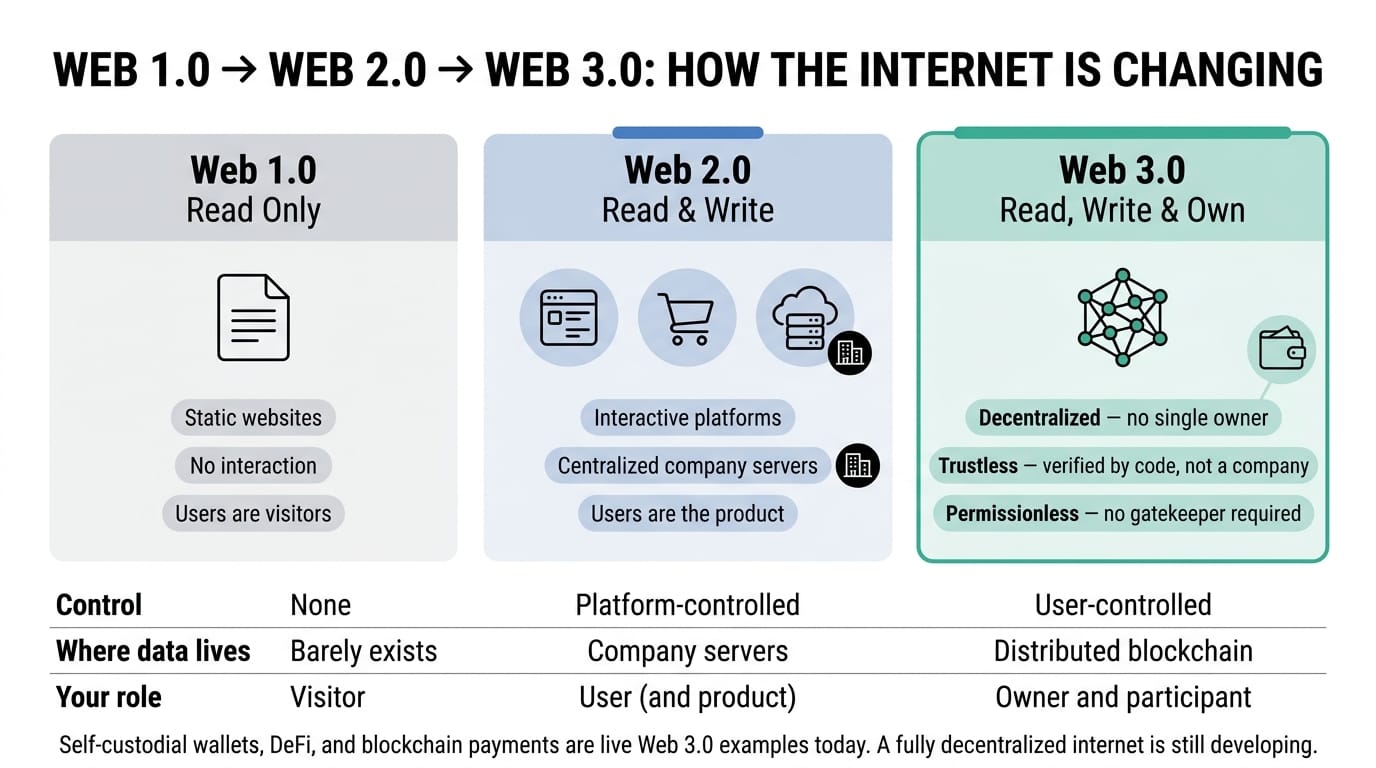
Web 3.0 is the name for the next stage of the internet, one built on blockchain technology instead of centralized servers owned by a handful of large companies, as CoinMarketCap's Web3 explainer puts it. Instead of a platform holding your data and your assets on your behalf, a blockchain network of independent computers verifies and records everything, and no single company controls it.
The easiest way to see the shift is to compare it to what came before:
| Web 1.0 | Web 2.0 | Web 3.0 | |
|---|---|---|---|
| How you use it | Read only | Read and write | Read, write, and own |
| Who controls it | Static websites, no interaction | Platforms like social media and marketplaces | Decentralized networks, no single owner |
| Where your data lives | Barely exists | Centralized company servers | Distributed across a blockchain |
| Your role | Visitor | User (and often the product being monetized) | Owner and participant |
Web 1.0 was the internet you could only read. Web 2.0 is the internet most people grew up on, interactive, but run by companies that store your data and, in a lot of cases, profit from it. Web 3.0 shifts ownership back toward the people actually using the network.
Three ideas come up constantly in any real explanation of Web 3.0. They sound abstract until you connect them to something you've probably already done in a crypto wallet.
No single company or server controls the network. Instead, thousands of independent computers (nodes) hold copies of the same blockchain and agree on what's true. That's different from Web 2.0, where one company's database is the only record that matters, and if that company goes down or gets hacked, so does your access.
"Trustless" doesn't mean untrustworthy. It means you don't have to trust a person or a company for a transaction to work, you trust the math instead. When you send crypto on a blockchain, the network verifies it through cryptography and consensus rules, not through a bank vouching for you.
Nobody needs to approve you to use a public blockchain. You don't apply for access, pass a gatekeeper's review, or wait on a company's terms of service to change their mind about your account. If you have a wallet and an internet connection, you're in.
Put together, these three traits are why a self-custodial wallet feels different from a traditional bank account or a centralized exchange. You're not asking permission. You're not trusting a company to hold your crypto safely. You're interacting directly with the network.
Yes, in meaningful part. Here's what's actually running today, not theoretical:
What isn't fully here yet is the more ambitious version of Web 3.0 you'll see described elsewhere, a fully decentralized internet where every app, social platform, and identity system runs on-chain. Britannica's overview of Web3 frames this broader vision well, even though most of it is still developing. Industries well beyond finance, from supply chains to healthcare, are also experimenting with blockchain infrastructure for the same reasons. But for anyone using crypto today, the practical building blocks are already in your hands.
If you buy, swap, or hold crypto regularly, Web 3.0 principles show up in decisions you're already making, whether you've labeled them that way or not.
None of this makes Web 3.0 risk-free. Smart contracts can have bugs, and a bug in code that manages real money is a real loss, not an abstract one. Self-custody means the responsibility for security sits with you, not a bank's fraud department. Understanding the trade-offs is part of using this responsibly, not a footnote you skip past.
Web 3.0 is the next phase of the internet, built on blockchain technology instead of centralized company servers. It shifts data ownership and control from platforms toward the people using the network.
Web 3.0 is largely why crypto works the way it does today. Self-custodial wallets, DeFi lending and swapping, and blockchain-based payments are all Web 3.0 concepts already in active use, not future developments.
A trustless transaction is one verified by cryptography and network consensus rather than a trusted third party like a bank. You don't need to trust the other person or a company for the transaction to be valid, the blockchain's rules handle that.
Core pieces of it are. Self-custodial wallets, DeFi platforms, and blockchain-based payments are live today. The more expansive vision, a fully decentralized internet covering every kind of app and platform, is still developing.
Not in technical detail, but understanding the basics (decentralization, self-custody, network fees) helps you make better decisions about how you store and move your crypto, and what you're responsible for versus what a platform would normally handle for you.
We explain crypto in plain, simple language with no hardcore technical stuff, so getting started feels easy, not overwhelming. Educational content only, not financial advice.
Buy, sell, and trade crypto on the go with RockWallet.