Why Banks and Fintech Apps Are Starting to Offer Crypto?
A year ago, your banking app didn't have a Buy Bitcoin button. Now plenty do. Here's why banks offer crypto now, what actually changed behind the scenes, and what it means for how you manage your money day to day.
You open your banking app to check your balance, and there's a new button sitting next to checking and savings: Buy Bitcoin. A year ago it wasn't there. Your credit union might have added one too, or the fintech app you already use for splitting rent with a roommate.
Why banks offer crypto now comes down to three things landing at once: new federal rules gave banks an actual path to touch digital assets, customers were already buying Bitcoin somewhere else, and fintech apps got there first. Banks and crypto weren't an obvious pair five years ago. So why do banks offer crypto today, and what does it change for you? None of it means every app offers the same thing, or that crypto became risk-free because a familiar logo sits next to the button.
Here's what actually changed, what your bank's crypto feature does and doesn't do, and how it stacks up against a dedicated crypto app like RockWallet.
Why banks offer crypto: the short answer
Three forces lined up close together. US banking regulators withdrew guidance that had kept banks from touching crypto, and Congress passed a law spelling out rules for dollar-backed stablecoins. At the same time, customers who wanted Bitcoin were already buying it through outside apps, taking that relationship with them. Fintech apps had offered crypto access for years, so banks and brokerages started catching up. Put together, the regulatory and competitive cost of staying out got higher than the cost of getting in. That's why banks offer crypto now, and not five years ago.
Why banks offer crypto now: the 3 forces behind the shift
People didn't wait for their bank's permission. They opened a crypto app, connected a debit card, and bought Bitcoin somewhere else entirely. Every one of those purchases was a customer relationship the bank wasn't part of anymore. Keeping crypto out of the banking app never stopped anyone from buying it. It just moved the relationship down the street.
Competitive pressure from fintechs and neobanks
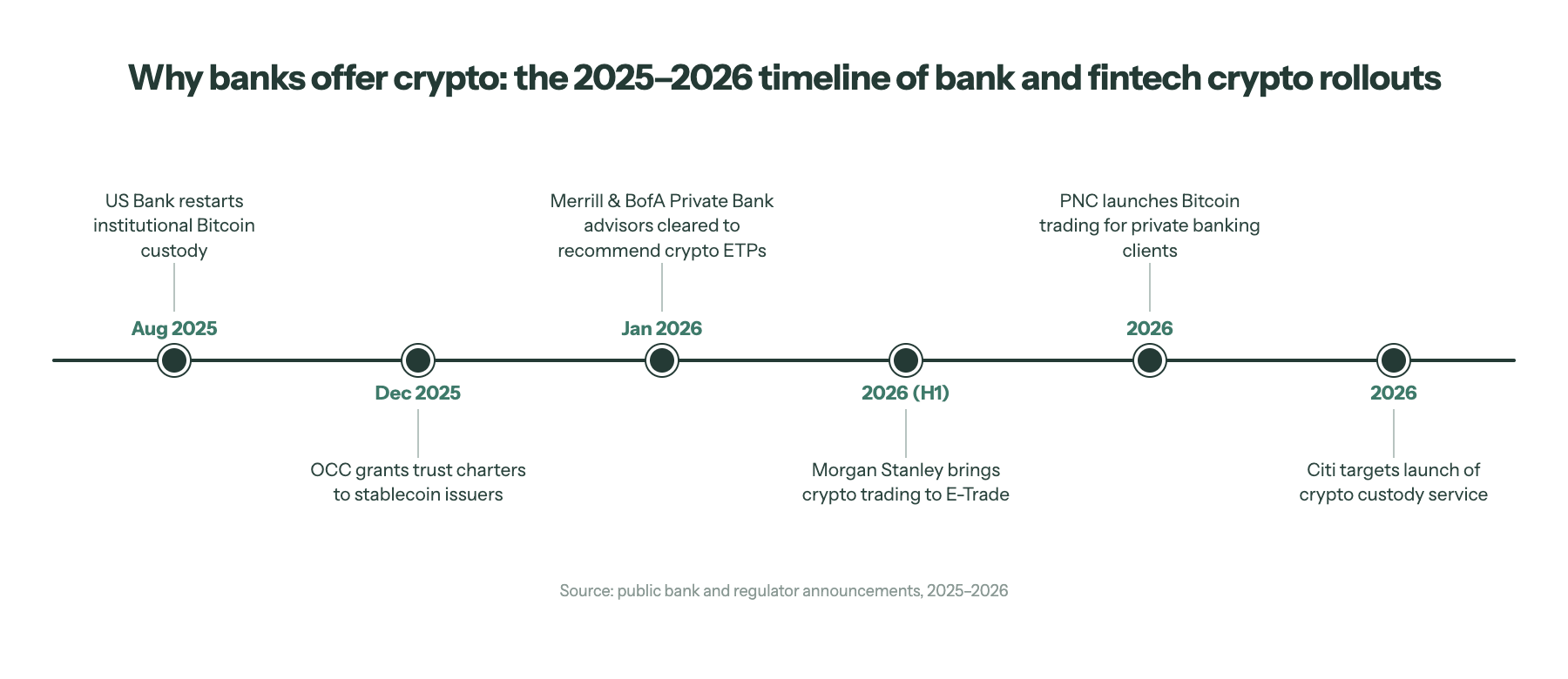
Fintech apps moved first and made buying crypto feel about as ordinary as paying a friend back. Banks and brokerages followed, fast. Morgan Stanley has officially completed the rollout of spot cryptocurrency trading to E-Trade clients in July 2026. PNC launched Bitcoin trading for its private banking clients. Bank of America Private Bank and Merrill cleared their advisors to recommend crypto exchange-traded products starting January 2026. None of these moved because crypto suddenly became a better investment overnight. They moved because a competitor already had the feature.
How banks and fintech apps actually offer crypto today
"My bank offers crypto" can mean a few very different things depending which bank you ask. Most banks don't build crypto infrastructure themselves. They partner with an outside provider that handles the plumbing: PNC works with Coinbase's infrastructure, and Morgan Stanley's E-Trade rollout runs on a platform called Zerohash. Some banks are building toward holding crypto assets directly on a client's behalf, which is what Citi is targeting for 2026, and what US Bank resumed for institutional clients in 2025. Others draw a clear line: JPMorgan has said it will let clients buy crypto but won't hold the asset itself.
That range matters, because it changes what you can actually do. A bank feature built around a single Bitcoin ETF recommendation is a very different thing from an app that lets you hold, send, and swap the asset itself. Worth checking before you assume your bank's version works the way you think it does.
What this means for your everyday money management
If you already bank digitally, having crypto in banking apps you use every day means one login instead of three, and one place to see your cash and your digital assets side by side. That's genuinely useful. It's also not the same as crypto becoming simple or risk-free just because a familiar logo is attached to it.
Think of it like your bank opening a small currency exchange counter right there in the lobby you already visit, instead of sending you three blocks down the street to a separate shop. Convenient, sure. You still need to know what you're exchanging into and what it costs, same as you would anywhere else.
Is crypto going mainstream? What the shift signals
Mainstream isn't measured by price swings. It's measured by infrastructure: regulated banks building custody services, financial advisors cleared to recommend crypto products, and a federal law setting rules for stablecoins that didn't exist two years ago. That's a different kind of shift than a speculative run-up, and a more durable one.
It doesn't mean every bank offers the same access, and it doesn't mean crypto became as protected as a savings account. Deposit insurance doesn't extend to crypto, no matter who's offering it. More on that in the FAQ below.
Bank crypto vs. a dedicated crypto app: what's different
Since bank crypto features vary so much, it helps to see them next to a platform built around digital assets from the ground up.
Bank or brokerage crypto feature
Dedicated crypto app
What's usually available
Often just Bitcoin, sometimes an ETF-style product rather than the asset itself
Bitcoin plus a broader range of digital assets
Who's involved
Your bank, plus a third-party crypto infrastructure partner
One platform built specifically for digital assets
What you can do with it
Varies, some only support buying and holding
Buy, Sell, and Swap between assets in one place
Your view of it
One line item among many banking products
A dedicated Portfolio built around your digital assets
What a dedicated app adds that a bank feature usually doesn't
A platform built for digital assets has one job: helping you buy, sell, and swap crypto, with a clear Portfolio that reflects it. In practice, that usually means more supported assets, the ability to swap directly between them without cashing out first, and a team whose whole business is this rather than a feature bolted onto something else. If you're picking your first app, our guide to choosing a crypto wallet as a beginner walks through what to look for.
How to build one portfolio, no matter where you bank
You don't have to wait for your bank's crypto roadmap to catch up to what you actually want to do. Getting started with a dedicated app is quick:
Download the RockWallet app.
Verify your identity once. It takes a couple of minutes.
Deposit funds.
Buy, Sell, or Swap Bitcoin and other digital assets, all inside one Portfolio.
Every fee shows up on screen before you confirm, so there's no math to do afterward. If security is what's holding you back, our beginner's guide to crypto security covers exactly what protects your account day to day.
One more thing before you dive in: buying and selling crypto has tax consequences in the US, whether you do it through a bank feature or a dedicated app. Our guide to crypto taxes covers what actually counts as a taxable event.
FAQ
Why are banks suddenly offering crypto?
Three things happened close together: regulators cleared a path for banks to handle digital assets, customers were already buying crypto elsewhere, and fintech competitors had a head start. Banks added crypto features to keep up on both fronts, not because crypto itself changed.
Is buying crypto through my bank the same as using a dedicated crypto app?
Not always. Some bank features only offer a Bitcoin-tracking product rather than the asset itself, and some limit you to buying and holding. A dedicated app usually gives you more assets to choose from and the ability to Buy, Sell, and Swap directly.
Is my crypto insured if I buy it through a bank?
No. FDIC deposit insurance doesn't cover crypto assets, even when a bank offers access to them. It only covers products like checking, savings, and CDs at an insured bank. Crypto carries its own risk, wherever you buy it.
Do all banks offer the same crypto features?
No. Some partner with outside crypto infrastructure providers for basic buying, some are building custody services, and others let you buy but won't hold the asset for you at all. Check exactly what your bank's feature includes before assuming it works like a dedicated app.
Is it safer to buy crypto through a bank or a dedicated app?
They carry different risks, not a ranking of safer and riskier. A bank feature depends on its infrastructure partner, and a dedicated app depends on its own security. Either way, Bitcoin's price can move regardless of who you buy it through, and that's the risk most people are really asking about.
Can I move crypto I bought through a bank into my own portfolio?
It depends on the feature. Some bank products, like ETF-style crypto shares, can't be withdrawn as the actual asset by an individual account holder. If you buy real Bitcoin directly, whether through a bank or a dedicated app, it can typically be sent to a wallet you control.
Aalind makes crypto, Web3, & DeFi easy to understand for newcomers, skipping the jargon & explaining things clearly. He's grown 30k+ followers & 6M+ views, & studied 100+ crypto projects. His writing is for education only, not financial advice.