Bitcoin has moved through four distinct cycles since 2009, each one tied to a halving that cuts new coin supply in half. This piece breaks down what drives that four-year rhythm, what the last four cycles actually looked like, and whether the pattern still holds up in 2026's very different market.
Every four years or so, the Bitcoin network goes through a big change that most people never notice. It has played a substantial role in shaping the price chart of Bitcoin every single time. It is called the halving, and it is the mechanism behind what people now call Bitcoin's 4-year cycle.
Picture a town which has just one bakery. This bakery cuts its daily bread output in half every four years. The number of hungry customers is growing day by day. As the population grows, this number of hungry customers will grow further. Now, since the demand is increasing day by day and the supply is getting halved, the price of bread will rise naturally based on demand and supply principles.
That is roughly what happens in the Bitcoin halving in simple terms. Four halvings have happened so far, in 2012, 2016, 2020, and 2024. Each one matches a part of Bitcoins history: a rise, a fall then a slow recovery.
What Is a Bitcoin Halving?
Bitcoin has a hard cap of 21 million coins. That means no new coins can ever be created beyond these 21 million coins. New coins enter circulation as a reward to the computers, called miners, that process transactions and keep the network secure. Roughly every four years, or every 210,000 blocks, that reward gets cut in half. Fewer new coins reach the market from that point forward, even though nothing about demand has to change at all.
The next halving is expected around 2028. The block reward will drop down to 1.5625 Bitcoin. Nobody has to write anything to make it work like this. Everything is already written in the code.
Why the Halving Lines Up With a Four-Year Cycle
The logic is pretty straightforward. It has to do with simple demand and supply principle. Every four years, the new supply is cut to half. Considering that the demand is constant or growing as seen historically, basic economics says the price has more room to move upwards. That is the logic behind Bitcoin's four-year cycle. It is not a law of physics. It is a pattern that has shown up four times, and patterns are worth understanding even when they are not guarantees.
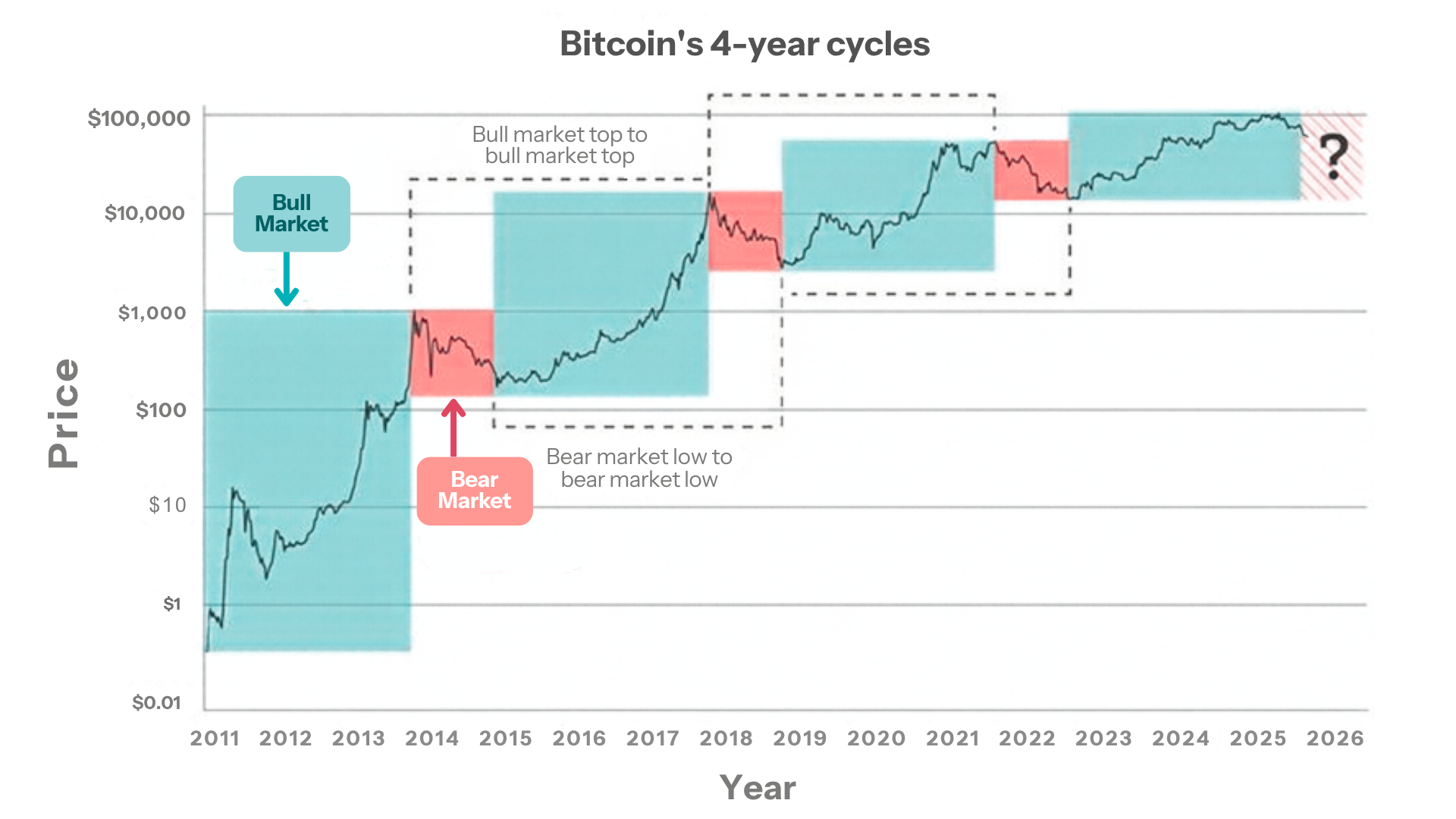
Each of the four completed cycles has followed a rough shape: a multi-year run-up as the market absorbs the lower supply, a sharp correction once that run-up outpaces actual demand, then a longer recovery before the next halving resets the clock. The timing has shifted from cycle to cycle. The size of the moves has shifted too. But the shape itself, up, down, rebuild, has held for over a decade now.
This shape does not tell you where the price goes next week. What it does is give some structure to the crypto basics most crypto-curious readers are trying to piece together.
Four Halvings, Four Cycles: What Actually Happened
Bitcoin 4-year cycles
Four halvings have been completed so far. This is how, the past four cycles compare, side by side. None of them looked exactly alike, and we need to look at the differences as much as we should look at the similarities.
2012 halving, the 2013 run
The first halving cut the block reward from 50 to 25 Bitcoin in November 2012. Bitcoin was not that famous and had barely left forums and message boards at that point, so there was no broad market to react. The price kept rising through 2013 then spent most of 2014 and 2015 slowly falling back down.
2016 halving, the 2017 run
By the second halving in July 2016, more people started paying attention. The 2017 run-up brought Bitcoin into mainstream news for the first time, followed by a multi-year correction that tested a lot of new holders' patience.
2020 halving, the 2021 run
The third halving took place in May 2020 right when pandemic-era stimulus was changing how people viewed money. Bitcoin reached peaks in 2021 then went through one of its biggest drops yet in 2022.
2024 halving, the cycle still playing out
The fourth halving reduced the reward from 6.25 to 3.125 Bitcoin in April 2024. Bitcoin hit a high near $126,000 in October 2025 then dropped about 50 percent to around $60,000 by early 2026 before bouncing back a bit. CoinDesk said gains since this halving have been weaker than in every cycle at the same stage, which the outlet links to Bitcoin simply being larger now. Moving its price now takes more capital than it used to, so the swings are getting calmer and volatility has reduced as a result.
Is Bitcoin's Four-Year Cycle Still Real in 2026?
More than 95 percent of all the Bitcoin that will ever exist has already been mined, according to CoinDesk. Only about 450 new coins enter circulation each day now, down from thousands in Bitcoin's early years. That is a much smaller supply cut for each future halving to work with, which is one reason some analysts question whether the old four-year rhythm can repeat in the same shape.
There is a second piece to this. Spot Bitcoin ETFs launched in the United States in January 2024 a few months before the fourth halving, giving large institutions an easier way to gain exposure without holding Bitcoin directly. That is one more variable in the mix that simply did not exist during the first three cycles.
Bitcoin's price has also started tracking the broader money supply and global liquidity conditions more closely, not just its own halving calendar. When central banks loosen policy, more capital tends to flow toward assets like Bitcoin regardless of where it sits in its halving schedule. When they tighten, the opposite tends to happen. That correlation has gotten harder to ignore.
None of this means the four-year cycle is dead, and it does not mean it is guaranteed to repeat either. It just means, there are more variable at play now than ever before. Bitcoin is fifteen years into an experiment nobody has run before. What used to move a small, thinly traded market barely moves a much larger one the same way. The honest answer in 2026 is nobody knows for sure. Anyone who says they do usually has something to sell.
What This History Actually Means for You
A pattern repeating four times is context, and should not be treated as a formula. It does not tell you when to buy, when to sell, or what Bitcoin will be worth next year, and anyone who tells you otherwise is guessing same as everyone else.
The history does support one thing: a steadier approach. Instead of trying to catch an exact top or an exact bottom, a lot of long-term holders spread purchases out over time and let the cycle do what it does. Others simply hold through the swings and check back in years, not days. Historically either approach has done better than reacting to every news headline.
Think of it not like a countdown clock but, like the seasons. You can’t say when winter starts but you can still wear warm clothes and dress for it. Bitcoin's cycle works the same way. You will not catch the exact turn, but you can decide ahead of time how you want to handle the ride.
Buying, Selling, or Swapping Bitcoin the Calm Way
Acting on any of this does not require perfect timing. Buy Bitcoin with fiat funds, hold it in your portfolio, or swap into other coins and tokens whenever you are ready. The new app gives you one regulated place to do all three at your own pace.
There is no pressure to catch a bottom or beat a countdown clock. Buy a small amount today, add more later, or hold what you already have and watch how the next stretch of the cycle plays out.
Download the app, buy your first Bitcoin, and take it from there.
FAQs
Does the Bitcoin halving always cause a price increase?
Not automatically. The halving reduces the rate of new Bitcoin entering circulation, but price is determined by supply and demand together. Historically, periods following halvings have included major price appreciation, but also significant corrections. Past performance does not guarantee future results.
How long does a Bitcoin bull market typically last?
Based on past cycles, the main appreciation phase has generally lasted anywhere from 12 to 18 months following a halving. But each cycle has played out differently, and past timing is not a reliable predictor of future timing.
When is the next Bitcoin halving?
The fourth halving happened in April 2024. The next halving is estimated to occur around 2028, based on the current rate of block production. The exact date adjusts with network mining speed and cannot be pinned down far in advance.
Is the Bitcoin 4-year cycle still relevant?
The halving schedule is fixed and will keep running. Whether the market pattern around it continues to look similar is less certain. As Bitcoin matures, institutional involvement deepens, and the macro environment changes, the pattern may look different in future cycles. Most analysts treat the cycle as useful long-term context, not a trading signal.
Can Bitcoin's 4-year cycle break?
The halving schedule itself is built into Bitcoin's code and cannot be changed without a network-wide consensus. The market behavior around it, however, is not guaranteed to repeat. External events, regulatory shifts, and macroeconomic conditions have all shaped past cycles in ways the calendar alone could not have predicted.
How much Bitcoin should I buy?
That is a personal financial decision. A widely shared principle in the crypto space is to only put in what you would be comfortable losing entirely. If you are new to Bitcoin, starting with a small amount and building your portfolio gradually tends to be a more manageable approach than going all-in at once. RockWallet lets you buy Bitcoin starting from whatever amount works for you.
Aalind makes crypto, Web3, & DeFi easy to understand for newcomers, skipping the jargon & explaining things clearly. He's grown 30k+ followers & 6M+ views, & studied 100+ crypto projects. His writing is for education only, not financial advice.