
What nobody explains about crypto wallets
Confused about how crypto wallets work? Here are the 5 things nobody explains upfront — in plain English, no prior knowledge needed.
Confused about how crypto wallets work? Here are the 5 things nobody explains upfront — in plain English, no prior knowledge needed.
You've heard about crypto. Maybe you've seen the headlines. You may have even opened an app, looked at a wall of charts and numbers, and perhaps quietly closed the app again.
Most crypto content is written for people who already understand crypto. It's assumed you already know: what a crypto wallet is, why you need one, and what happens if you do something wrong. What's missing out there are the foundational elements, the stuff you dont want to skip when where you're sitting thinking: wait, but what is a wallet, exactly?
Here are the 5 things nobody explains about crypto wallets, until you need to know them.
This is the one that trips everyone up first.
Your crypto doesn't live inside the wallet app. It lives on the blockchain, a public, permanent record of who owns what. What your wallet holds is a key. A unique digital credential that proves the crypto belongs to you and lets you move it.
Think of it like a safety deposit box at a bank. The box is on the blockchain. Your wallet is the key. Without the key, you can't get to what's inside. With it, you have full access.
This distinction matters more than it sounds. It's why losing access to your wallet is serious. And, it's why choosing the right wallet, one with a proper backup system, is one of the most important first steps you'll make in crypto.
A lot of people buy cryptos on exchange platforms like Coinbase and assume that's it. Their crypto is safe, they're done.
Here's what's happening: their apps hold your crypto on your behalf, controlling the keys. You have an account balance that says you own X amount of Bitcoin, but you don't hold the key yourself. It's an IOU.
That's called a custodial arrangement. For some people it's the right choice. There's a team behind the platform, and if something goes wrong with your account, there's someone to call. The trade-off is that you're relying on that platform to stay secure, stay solvent, and stay accessible. Platforms have frozen withdrawals during volatile markets. Some have shut down altogether, leaving customers waiting months to recover funds, if they recovered them at all.
A non-custodial wallet means you hold the controlling share of your own key. Your crypto lives on the blockchain. That's true regardless of which wallet you use. The difference is who controls access to it.
If you've looked into self-custody wallets, you've probably hit the seed phrase wall (a list of 12 to 24 random words that acts as the master key to your wallet).
Most wallets ask you to write down 12 to 24 random words, in the exact right order, on a piece of paper. Then store that paper somewhere safe. Forever. And never, ever lose it.
Because if you do? Your crypto is gone. Permanently. No support team. No password reset. No recovery.
This is not a small ask. It's asking a first-time user to become their own bank security department in their first five minutes. It's one of the biggest reasons people who want to try crypto quietly decide not to.
The good news: this isn't the only way anymore. Newer wallets have solved this problem without asking you to go at it completely alone.
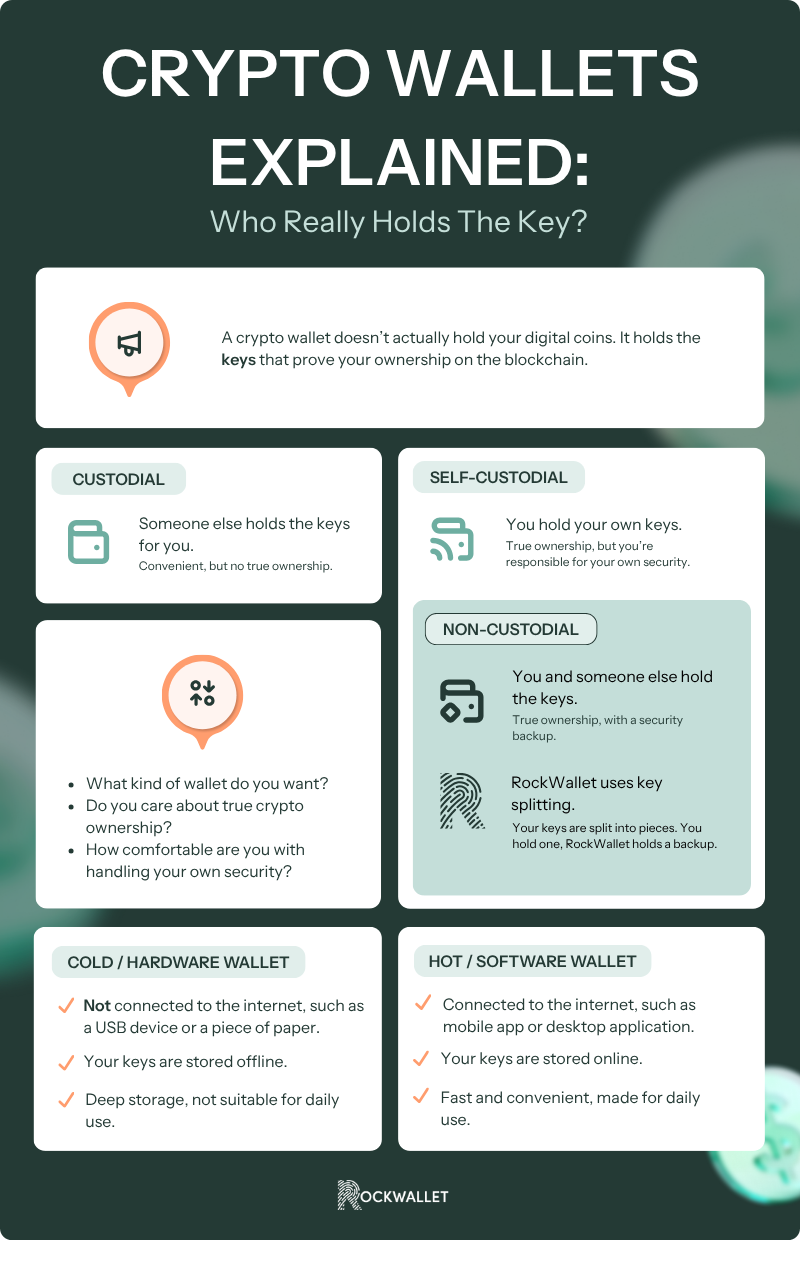
There are: hot wallets, cold wallets, custodial wallets, non-custodial wallets, hardware wallets, software wallets. The categories overlap. The terminology is inconsistent. It's genuinely confusing.
The most important question is: who controls the keys?
If a platform controls your keys entirely (like Coinbase or Robinhood), that's custodial. You don't directly control the keys, but there's a team you can turn to if something goes wrong. If you hold the controlling share of your own key, that's non-custodial. You have real ownership of your crypto and with the right wallet, a safety net for when things go wrong too.
Beyond that, the other big distinction is online versus offline. Wallets connected to the internet, aka hot wallets, are convenient for everyday use. Cold wallets, often a physical device, keep your private keys offline, making them more secure for large amounts you're not touching often.
For most people getting started, a well-designed mobile wallet that gives you real ownership of your keys, without requiring you to become your own security department, hits the right balance.
Crypto apps weren't designed for you. They were designed for people who already knew how this worked, who got in early, figured it out the hard way, and then built tools for people like themselves.
That's changing. But slowly. The five things above aren't advanced concepts. They're the basics. They're just not explained anywhere that a normal person would think to look.
Now you know. And that's enough to get started.
Your first step into crypto, with plain-language guidance at every tap, and a security model that doesn't ask you to memorize anything.
Read more: Nobody told me my crypto on an exchange wasn’t really mine.
A crypto wallet doesn't actually store your crypto. It stores the key, a digital credential that proves specific crypto on the blockchain belongs to you and lets you move it.
With a traditional wallet, losing your seed phrase means losing access to your crypto permanently, with no support team or password reset able to help. This is exactly the kind of risk that's pushed wallet design toward better backup and recovery options.
A custodial wallet is one where a company holds the keys on your behalf. You have an account balance showing what you own, but the platform controls access to it.
Look for a mobile wallet that gives you real ownership of your keys without requiring you to manage a seed phrase yourself. That combination gives beginners the security of holding their own crypto without the steep learning curve that used to come with it.

We explain crypto in plain, simple language with no hardcore technical stuff, so getting started feels easy, not overwhelming. Educational content only, not financial advice.
Buy, sell, and trade crypto on the go with RockWallet.