
What nobody explains about the 12-word recovery phrase
The seed phrase stops most people from ever owning their crypto. Here's what it is, why it's a real problem, and how modern wallets have solved it.
The seed phrase stops most people from ever owning their crypto. Here's what it is, why it's a real problem, and how modern wallets have solved it.
You decided to try a non-custodial wallet. You wanted to own your crypto, not just have a balance on someone else's platform. You downloaded a wallet app, felt good about the decision, and then it asked you to do something that stopped you mid-action.
Write down these 12 words. In this exact order. Store them somewhere safe. This is the only way to recover your wallet. If you lose this, your crypto is gone forever.
Most people close the app right there.
You are being asked, in your first five minutes of using a crypto app, to become your own bank security department. The stakes are permanent. The margin for error is zero. And nobody warned you it would be like this.
Here is what is going on, why the seed phrase model has real limitations, and why newer wallets have found a better approach.
When you create a non-custodial wallet, the app generates a private key. Think of it as a unique digital credential. That is, an extremely large number that proves ownership of your crypto and allows you to move it. No company controls it.
The challenge is that this number is far too large for any person to write down or remember accurately. So, wallet developers came up with a practical solution.
They take that number and convert it into a short list of ordinary English words. Usually 12, sometimes 24. The words come from a standard list of 2048 common words, and the specific combination generated for your wallet is unique to you.
That list is your seed phrase. It is also called a recovery phrase or mnemonic phrase, depending on the app.
Here is the important thing to understand: the crypto seed phrase does not just represent your wallet. It is your wallet. Anyone who has those words, in that order, can import your wallet into any compatible app and access everything in it with no additional verification required.
And if you lose the words and lose your device at the same time, there is no recovery path. The crypto remains on the blockchain, but the key to access it no longer exists.
The seed phrase was designed in the early days of crypto, primarily for technically experienced users who were comfortable managing their own security infrastructure.
For everyone else, it creates a genuine challenge.
Storing the phrase digitally, in a note's app, a photo, or an email, creates a security vulnerability. Anyone who accesses those accounts could find it. Storing it on paper introduces physical risk. The phrase needs to be kept somewhere secure, separate from your devices, and protected for as long as you hold the wallet.
Some experienced holders engrave their seed phrase on metal and store it in a fireproof safe. That is a legitimate approach for significant long-term holdings. It is also a considerable ask for someone who wants to take a first step into crypto ownership.
The deeper issue is timing. The seed phrase confronts users in their first moments with a wallet, before they have any sense of what secure storage looks like in practice and before the stakes have had a chance to feel real. The result is predictable: some people handle the phrase carefully, some handle it carelessly, and many decide the whole thing is more complicated than they want to deal with right now.
The core challenge is straightforward: you want to own your crypto yourself, but you also need a way to recover access if your device is lost, stolen, or replaced.
The seed phrase is one solution to that tension. You keep a written copy so you can reconstruct access later. The limitation is that it places the entire security burden on the user, with no assistance available.
What if that responsibility could be shared, without giving up meaningful control?
You carry part of the key. A trusted party carries another part. Neither piece alone is enough to access the wallet. Together, with your authorization, they work. If you lose your device, the trusted party's piece helps you recover.
That is the principle behind key-splitting, a well-established method from cryptography that has been used in banking and secure data systems for decades.
Here is the core idea without the technical detail.
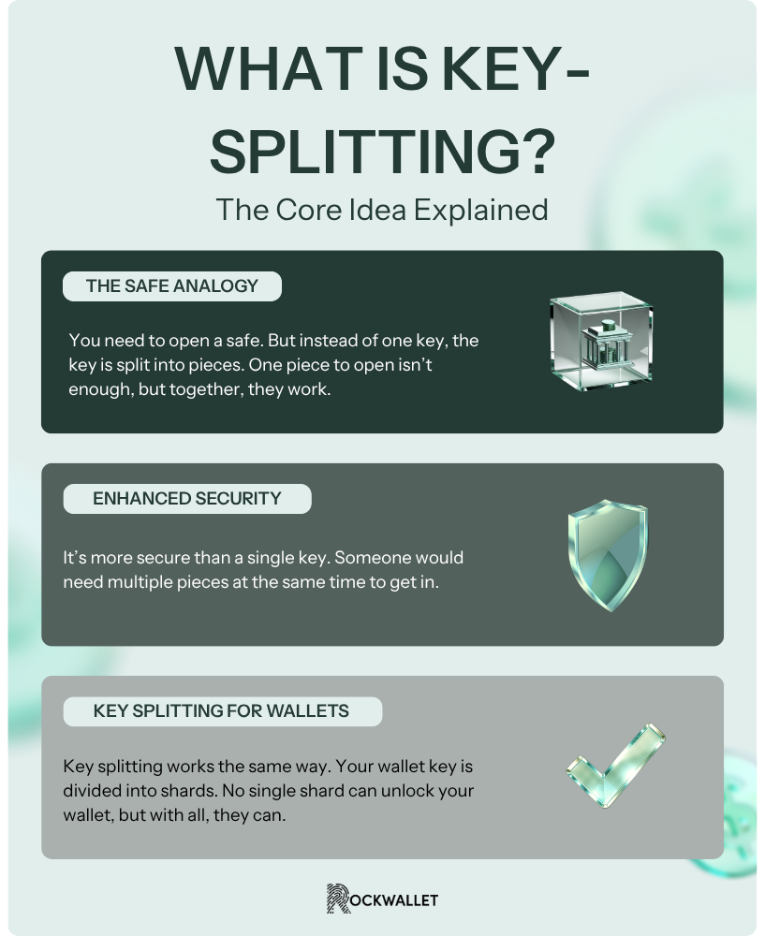
Imagine opening a safe that requires 2 keys turned at the same time. You have one key. A trusted party has another. Neither of you can open the safe alone. Together, you can — but only when both parties are present and willing.
Key-splitting applies this logic to your wallet. Instead of one key that you protect entirely on your own, the key is divided into multiple pieces called shards. Accessing the wallet requires a specific number of shards to work together. No single shard is sufficient on its own.
When you create an account with RockWallet, the wallet key is split into three pieces called shards. You hold one shard, secured by your phone's passkey or Face ID. RockWallet holds a second shard on its own secure servers. A trusted third party holds the third shard, stored separately and used only when needed.
To authorize any transaction, 2 of those 3 shards need to work together. No single party can act alone, not you, not RockWallet, not the third party.
Since RockWallet holds its own shard, it also could refuse to co-sign a transaction it believes is fraudulent. A fully independent wallet cannot do that for you. RockWallet can and does.
If you lose your phone, you have lost your shard. But the other two shards still exist. You verify your identity through the app, confirm it is really you, and the remaining shards work together to restore access to your wallet on a new device. Your crypto was on the blockchain the entire time. Nothing moved. Nothing was lost. You just got a new key cut.
There is no 12-word list to dig out of a drawer. No safe deposit box. No moment of cold panic when you realize the notebook is gone.
A reasonable question at this point is: if RockWallet holds a piece of my key, do I really own my crypto?
Yes. Here is why.
RockWallet's shard alone cannot access your wallet. It takes 2 of the 3 shards working together to authorize anything, and your shard is always one of the two required for a normal transaction. RockWallet cannot move your funds without your involvement. The crypto itself sits on the blockchain, not in any RockWallet account or database.
That is what makes this non-custodial. It is meaningfully different from a custodial exchange, where the company holds the entire key and you hold only an account balance. Here, you are a co-holder of access, not a customer with a balance.
The trade-off is that RockWallet is involved in your recovery process. For some people, especially those with very large holdings who want zero counterparty involvement, a fully independent hardware wallet with a carefully stored seed phrase is the right choice.
For people who are getting started, who want real ownership without a ritual that makes crypto feel more dangerous than it should, this model removes the barrier that was keeping non-custodial wallets out of reach.
If you are already using a wallet with a seed phrase and want to keep it, here is the honest guidance.
Write the phrase down by hand. On paper. Not in a notes app, not in a photo, not in an email draft.
Store it somewhere physically secure that is separate from your phone or computer. A fireproof box is worth the investment if you are holding anything meaningful. Some people use a bank safe deposit box for large amounts.
Never share the phrase with anyone. Not a support agent. Not a friend helping you troubleshoot. Not someone who says they are from the wallet company.
The seed phrase is an honest solution to a real problem, built for a specific kind of user. The limitation is that it was presented to everyone as the only solution, regardless of whether it suited them.
It is not the only solution anymore.
Owning your crypto should not require you to take on the full responsibility of a security professional before your first transaction. The technology to offer a better experience has existed for years. Key-splitting is how that experience becomes available without giving up what matters: your crypto on the blockchain, under your control, recoverable when you need it.
RockWallet splits your wallet key so you never face the seed phrase problem.
Your key is divided, backed up securely, and recoverable if you lose your device, without asking you to store or memorize anything.
Next up: “Top 5 crypto scams to watch for as a newcomer”
Disclaimer: The information in this article is for educational purposes only and should not be construed as financial advice. Cryptocurrency investments involve risk, including possible loss of principal. Past performance is not indicative of future results. RockWallet does not provide investment advice. Please consult a qualified financial professional before making investment decisions.
We explain crypto in plain, simple language with no hardcore technical stuff, so getting started feels easy, not overwhelming. Educational content only, not financial advice.
Buy, sell, and trade crypto on the go with RockWallet.